
As a healthcare simulation tool manufacturer, we receive a fair number of unusual requests from our customers. Often, they begin like rain: one email drops, then another, and before long, the pattern becomes impossible to ignore. Eventually, we reach the point where doing something about it feels less like an option and more like a necessity. This article is about one of those requests, and how we came to address it.
To begin, I should introduce myself as a trained engineer. Contrary to many of my fellow problem-solvers, who would rather live in a cave and never come out, I too happily live in caves, but also love getting out to meet our awesome customers and visit their simulation installations around the world, as often as my schedule allows.
Apparently, being welcoming is a rather common trait among simulationists. I am lucky enough to get installation tours on almost every visit, and to see and learn about a wide variety of setups and contexts. Typically, after going through different theaters, I inevitably end up in front of a spaceship-like control desk. Having spent a fair number of years in the audio processing field before meeting the healthcare education challenges, I have always had a particular interest in the audio side of things. There, I have been very well fed, so to speak, and amazed by the variety of audio setups and the creativity involved. From the ‘cans and wires’ setup to the high-priced audiophile system that you are not allowed to touch, unless you wear gloves, most setups feel unique, and that always strikes me. In front of that sacred spot, I would often hear statements along these lines: ‘I am losing my voice lately. My voice acting is not that good, and the students break out of the scenario when this kid manikin sounds .. like me. Can you help with this?”, my host reaching for a glass of water.
Simulation educators not only take on the role of voice actors, but often have to aim for a Celine Dion-style imitation more often than they would enjoy. Students often recognize the teacher’s voice, which certainly makes for memories that “stick”.
Sometimes, the musician of the team might slip in the setup a guitar pedal to help with the voice pitch. For the even luckier ones, it might be a singer’s voice-changing processor, which can do a decent job with some effort, but whose controls are sometimes poorly suited to the day-to-day reality of simulation work.
Another common characteristic of those audio systems is that they are often the creation of a single mastermind. If, saddly, that mastermind is stuck at home because of a broken toe, on the day of the epic final exam, and the audio system decides to go on strike, the team is left with no other option than hiding the smallest team member under the bed to voice the manikins..
Now that I have brought back all those painful memories, let me walk you through the solution we, at Innov2Learn, developed to address those pain points: the VoiceQast Kit.
The solution: The VoiceQast kit
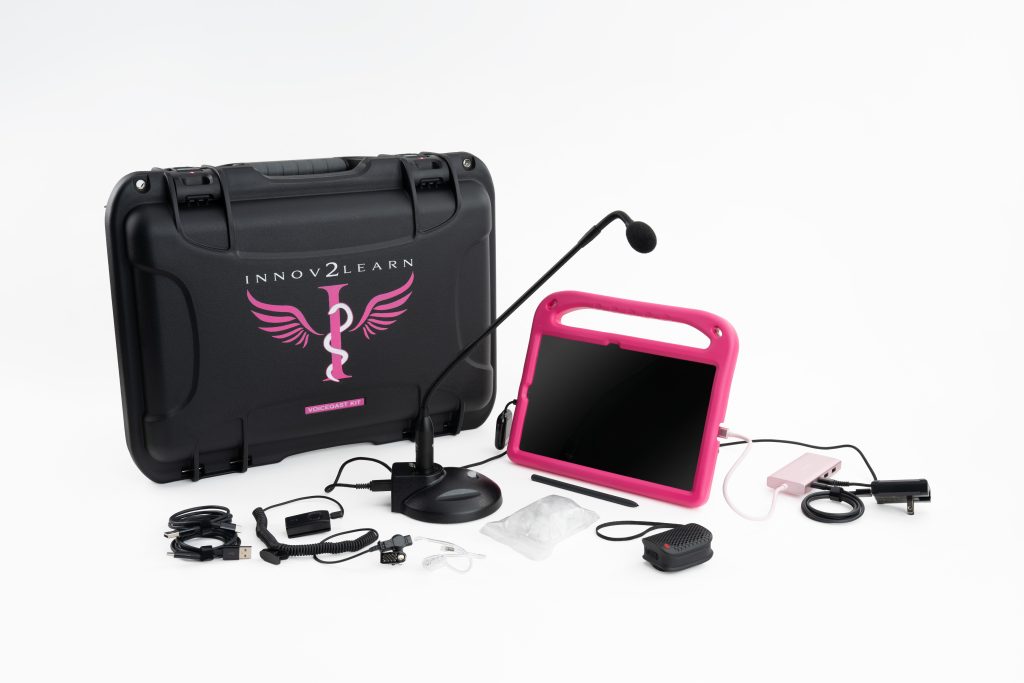
The VoiceQast Kit is an all-inclusive solution that gives voice to your manikin, while allowing you to communicate with your actors.
One guiding principle behind the solution was that we wanted to create a voicing kit that would be usable right out of the box, without the help of a technician. (that mastermind we talked about, she is busy enough and has other things to do.)
We designed it to let you give a realistic voice to that older-than-you, lo-fi manikin as well as to that just-arrived, state-of-the-art manikin with the alarmingly stiff voice.
We also made it possible for you to toggle between voicing your manikin and communicating with actors at the push of a single button.
We wanted to create a system that would be easier on your voice and reduce the hundreds of hours you have to put into practicing impressions, or into perfecting that ‘convincing snoring’ your colleague inevitably requests every year at the Christmas party. You should be able to skip the cigarette pack supposedly needed to play the older guy. Truly, no more straining your voice to the point that your family asks why you sound funny tonight. The kit does it for you.
We introduced a tablet-based, easy-to-control VoiceChanger with various presets, along with a three-setting tunable changer that covers a range of target voices. With large buttons and controls that are easy to see in the dark, controlling the system is painless, even on the day you forgot your glasses at home.
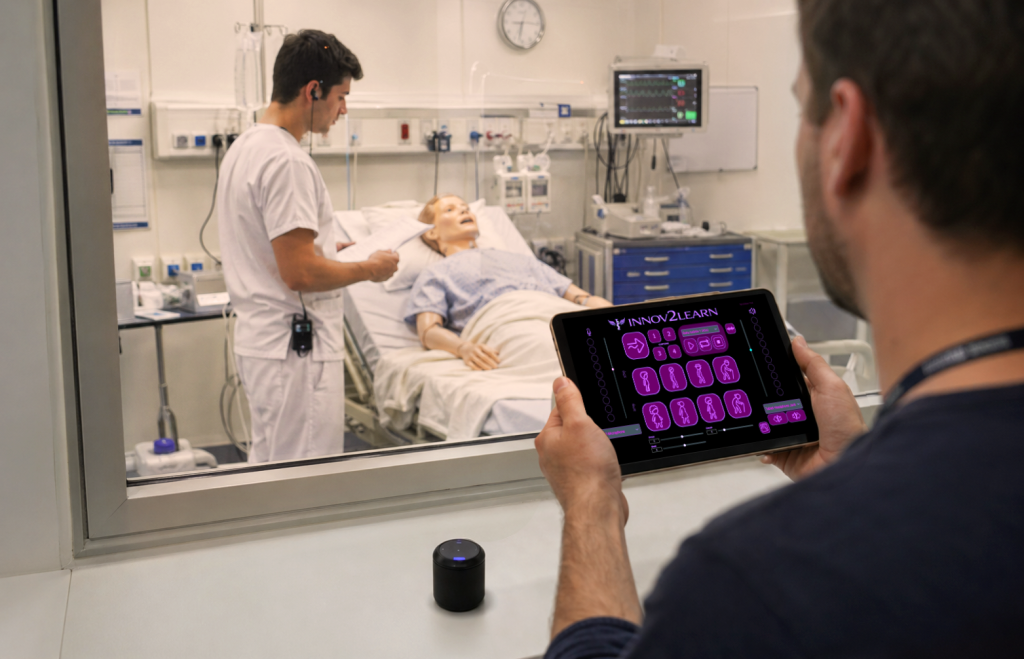
The VoiceChanger also includes a fully fledged sound sample panel, which allows you to play or loop a variety of sounds, including your own. The baby is in pain, but you do not feel like pinching your nose and crying endlessly into the microphone? Just press the ‘Baby cry’ loop button. Want to get back at that annoying student? Press the infamous ‘Adult burp’ button. If your scenario requires it, you can make your manikin cry, vomit, laugh, and discuss the latest headlines, all at the same time since it supports playing 8 sounds simultaneously.
The VoiceChanger APP comes free with the kit. We also provide free updates to kit owners to make sure that the kit in your hands remains the best solution around. (Yes, they will be jealeous.)
The kit comes with a high-quality directional gooseneck microphone designed specifically for speech capture. Its directional pickup pattern also helps you avoid the audio feedback loops that are common with traditional microphones.
A loud and portable battery-powered speaker is provided. With its clip and magnet, you can easily hook it behind the back of your manikins, or on its bed side. Its sound is loud and clear. Students will finally understand what the manikin is saying, even in loud environments.
We created a system that would be useful in most environments. Using fully battery-powered, wireless components provides that flexibility by allowing voicing indoors as well as outdoors. There is no need for wifi, to trip over wires or follow them up and down through five walls. The kit portability extends manikin voicing to pre-hospital care, such as on-site emergency response simulations.
We carefully selected every component for their quality, ease of use and compatibility. In the end, we made a tool that will not only save you time, but will bring up the room’s energy, add a great deal of realism, and certainly make the training adventure even funnier for everyone.