
Escape Room Recruitment Pilot at Collège Gérald-Godin
Escape room initiatives in healthcare education often begin with a familiar challenge: many programs struggle to equip their labs adequately. Equipment is costly, and lab budgets can be difficult to unlock. Meanwhile, Communications and Marketing teams frequently have funds specifically allocated for recruitment.
“Could this technology help recruit more students into our program?”
At the time, we couldn’t answer with confidence. We could describe the educational value and ease of use, but we lacked evidence that the devices could directly support recruitment outcomes. After product development and real-world deployments, we tested the idea in a focused pilot, and the result was clear:
Yes. Innov2Learn technology can be used as a recruitment tool.
That matters because recruitment budgets are often easier to unlock than lab-equipment budgets.
Lab Funds: Financing Lab-Level Experience Through Recruitment
The pilot was built on one practical idea: if the objective is recruitment, fund the activity as a recruitment initiative rather than as a lab purchase. Innov2Learn’s simulated point-of-care devices are realistic, Bluetooth-controlled, and easy to deploy, making them a strong fit for interactive outreach activities that prioritize engagement and memorable experiences. (VoiceQast Kit, Control app, Gluco-mini, Forehead-T, Oxi)
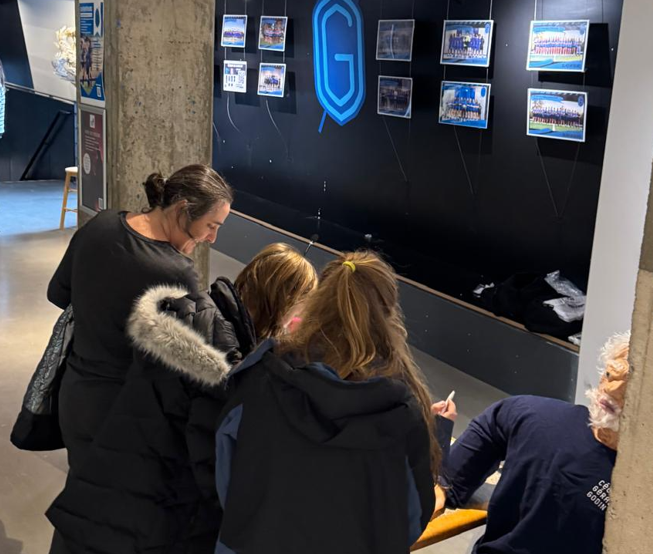
We put the concept to the test at Collège Gérald-Godin during an open house.
The open house concept: Save the old man
Audience and constraints
Target audience: high school students visiting with friends and family. Format constraints:
- Fun and entertaining
- Challenging enough to feel rewarding
- Simple enough to avoid frustration
- Flexible for 1–4 participants
- Short (max 10 minutes) to keep traffic flowing
Scenario and flow
Mission: save the life of an ill elderly man before time runs out. To simplify setup and transport, we used an inflatable manikin. Groups progressed through a short sequence of tasks:
- Take vitals using Innov2Learn devices
- Convert units using basic math
- Organize information correctly
- Listen to symptoms and interpret cues
- Determine the correct sequence for the lock code
- Open a protective case before the timer ends
- Retrieve the medication and “save the patients.”
The final unlock contained a satisfying reward: the medication, a candy, and a mini celebration kit (lab coat, stethoscope, Polaroid camera). We printed a victory photo on the spot and affixed a QR code with the event date to the back so participants could revisit the nursing program page later.
To avoid spectators spoiling the solution, we rotated between four preset lock combinations so each group still had to solve the challenge.
Execution and results
The pilot delivered the intended outcome: a steady line of students waiting to “save the old man.” Parents reacted positively, and several highlighted the activity’s creativity and relevance as a recruitment tool. One parent called it “a very clever initiative to promote the program.”
Mélodie Laplaine, Assistant Director of Studies, Student Life, and Community Engagementat Collège Gérald-Godin, shared this feedback:
Original (FR):
“Super concept! Les participants semblaient ravis de l’expérience. J’ai moi-même testé l’activité et j’ai adoré! Une excellente idée pour le recrutement d’une façon ludique et animée. Merci pour cette belle opportunité 😊”
English translation:
“Fantastic concept! The participants seemed delighted with the experience. I tried the activity myself and I loved it. An excellent idea for recruitment in a fun and engaging way. Thank you for this great opportunity.”
What made the escape room work
Several deliberate design choices turned a good idea into a smooth, high-throughput activity:
Voice immersion with VoiceQast
We used the VoiceQast Kit to modulate the facilitator’s voice and convincingly mimic the elderly patient, adding realism and fun without operational complexity.
Bluetooth remote control, not Wi-Fi
Bluetooth-controlled simulated devices reduced operational risk and simplified setup in an unpredictable open-house environment where Wi-Fi can be unreliable.
Scenario Mode for consistency
The control app allowed us to preset multiple readings and send them in real time, keeping the experience consistent and fast as groups rotated. (Control app)
Devices used
- Gluco Mini simulated glucometer
- Forehead-T simulated forehead thermometer
- Oxi simulated pulse oximeter
The hidden advantage and scalability
The devices are not “recruitment-only.” After outreach events, they return to their core role supporting healthcare education and simulation training. The escape-room format scales beyond nursing: with adjusted storylines and clinical cues, it can be adapted for respiratory therapy, paramedics, firefighter training, and other public-safety disciplines.
A variation of this pilot is already being designed for a Respiratory Therapist program using the same principles with discipline-specific cues.
Your turn
Have you run an escape room, serious game, or recruitment activity for a healthcare or public-safety program? Share what worked and what didn’t. If you have a concept to test, tell us your constraints (time limit, audience size, program type, space limitations) and what you want participants to remember when they leave.